 Skip to Content


Cameras On: Florida Supreme Court Weighs the Next Rule for Remote Mediation
 By: Steven Gendreau, Esq.
Remote mediation is not going away. But disappearing from one might.
The Florida Supreme Court recently heard argument on a proposed amendment to Florida Rule of Civil Procedure 1.700 that would address a distinctly modern mediation problem: participants who turn off their cameras, mute themselves, and effectively vanish from the proceeding.
The proposal sounds simple. If mediation is conducted remotely, participants generally should be seen and heard.
The debate surrounding that proposal is more complicated.
The Problem: “Present” Does Not Always Mean Present
Remote mediation became commonplace during the COVID-19 pandemic. It stuck around for good reason. Lawyers, clients, adjusters, and mediators can participate from different cities—or different states—without spending hours traveling to sit in separate conference rooms.
But convenience has created its own problem.
As reported by The Florida Bar News, members of the Civil Procedure Rules Committee described participants turning off their cameras and muting themselves during mediation. Committee member Melisa Bodner told the Court that nearly every member of the committee had encountered the issue.
That raises an obvious question: If someone turns off the camera and microphone, are they still meaningfully participating in the mediation?
Justice Jorge Labarga zeroed in on that point during oral argument, asking whether a participant who turns off the camera is still mediating. The answer, according to Bodner, is not always clear.
And therein lies the problem.
A name appearing in a Zoom window proves that someone logged in. It does not prove that person is paying attention, participating in negotiations, or even sitting in front of the computer.
The Proposed Fix: Cameras On
The proposed amendment to Florida Rule of Civil Procedure 1.700 would preserve a preference for in-person mediation while allowing a judge to order—or the parties to agree to—mediation through communication technology.
When technology is used, however, the proposal would generally require both audio and video, unless the parties agree otherwise or the judge finds cause for an exception.
The concept is straightforward: if the parties choose the convenience of remote mediation, they should still bring the engagement expected at an in-person mediation.
Florida’s existing best-practices guidance already points in that direction. The Florida Bar’s 2022 Recommended Best Practices Guide for Remote Court Proceedings states that cameras should remain on and participants should remain visible while conferring with the mediator, absent an exception.
The proposed amendment would give that expectation more teeth.
But “Cameras On” Has Its Own Problems
Not everyone supports the proposal.
The Supreme Court’s Committee on Alternative Dispute Resolution Rules and Policy and The Florida Bar’s Alternative Dispute Resolution Section oppose the amendment. One concern is practical rather than philosophical: internet connectivity.
For lawyers and litigants with reliable broadband, simultaneous audio and video may seem like a minimal requirement. That assumption does not necessarily hold throughout Florida.
Opponents told the Court that litigants in rural areas may lack connections capable of reliably supporting both audio and video. Requiring cameras throughout the proceeding could therefore create a barrier to participation rather than improve it.
There is also a more fundamental question: Does Florida need a statewide rule to solve a problem mediators can address themselves?
Chief Justice John Couriel questioned whether the issue needed to be handled by rule at all. Justice Adam Tanenbaum similarly questioned why a mediator could not simply confront a participant who abruptly turns off a camera.
Those questions get to the heart of the debate.
Remote Mediation Changed the Practice—Mostly for the Better
For Florida civil litigators, the appeal of remote mediation is difficult to ignore.
A mediation that once required several attorneys, claims professionals, corporate representatives, and clients to travel across Florida can now occur without anyone leaving the office. That saves travel time, reduces expense, and often makes scheduling substantially easier.
There is no reason to abandon those advantages.
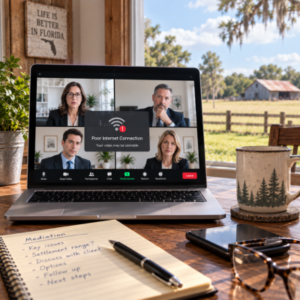 But remote mediation works only if remote participation remains actual participation.
Mediation is more than an exchange of numbers. A mediator watches reactions, evaluates positions, tests assumptions, carries messages between rooms, and tries to determine where movement is possible. Lawyers counsel their clients. Claims professionals evaluate new information. Parties make decisions as negotiations develop.
That process becomes harder when a participant goes dark.
And anyone who has spent enough time in remote proceedings knows the difference between someone who is attending remotely and someone who is merely logged in remotely.
The Better Question Is Not Where You Mediate. It Is Whether You Participate.
The debate over Florida Rule of Civil Procedure 1.700 reflects a broader challenge facing Florida’s courts.
Technology has made litigation more efficient. Depositions, hearings, conferences, and mediations can now occur remotely when circumstances once would have required everyone to appear in person.
The goal should be to preserve those efficiencies without allowing convenience to dilute participation.
Whether the proposed amendment is ultimately adopted remains for the Florida Supreme Court to decide. The proposal is pending in In re: Amendments to Florida Rule of Civil Procedure 1.700, Case No. SC2025-2041. But the dispute has already highlighted a useful principle for practitioners:
Remote should describe where the participant is—not how engaged the participant is.
When mediation begins, showing up should still mean showing up.