 Skip to Content


Could AI Data Centers Lead to Eminent Domain in Florida?
 By: Carlos A. Kelly, Esq.
Artificial intelligence impacts many aspects of everyday life. You, like many other people, use AI for a variety of tasks. The uses range from your home to your business. At home, you may be using AI to prepare a menu for your backyard barbecue or help you decide what home improvements will add the most value. At your business, you may be using AI to prepare customer-facing documents, create task or flow-charts, or route potential clients to the right team member. And other businesses are using AI for more sophisticated tasks, such as assisting physicians in diagnosing patients and even guiding a surgeon’s hands in real time.
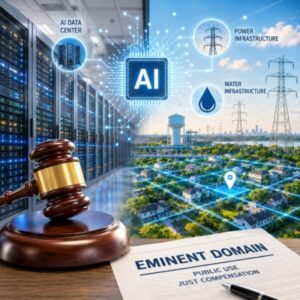
For all of this to take place, AI requires more and more infrastructure: electric power to run the tens of thousands to millions of microprocessors and a water supply to regulate the high temperatures generated by the operation of those microprocessors. One commentator suggests a non-AI data center can routinely consume the same amount of electricity as anywhere from 10,000 to 25,000 households, while an AI hyperscale data center can consume as much electric power as 100,000 households. The same commentator also compares the water requirements of a larger AI data center to the requirements of a city of 50,000 people. This creates significant additional demand on resources, and causes the real potential for higher utility bills, both for families and businesses.
These are only some of the reasons that you, like many other people, don’t want AI data centers anywhere near you.
 Dr. Meagan Baskin, a full professor in the Lutgert College of Business, Florida Gulf Coast University, and director of the Southwest Florida Leadership Institute at Florida Gulf Coast University, sees additional issues. “AI can ultimately result in the displacement of people, a displacement of humanness, physically or mentally, or both.”
All of this raises a potentially troubling question for Florida property owners and businesses as AI data center development expands across the state:
Could the infrastructure needed to support artificial intelligence lead to the use of eminent domain?
The answer is yes, and here’s why.
What Infrastructure Do AI Data Centers Require?
In addition to increased electric and water supply, new AI data center development may require:
- Water and wastewater system improvements
- Road improvements and supporting infrastructure
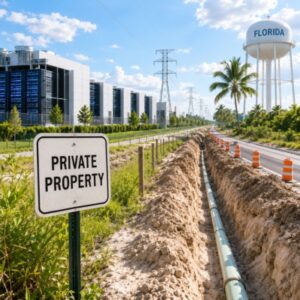
For Florida property owners, that infrastructure may be built miles from the AI data center itself, but still cross privately-owned land, whether in the city or in the country, before reaching the data center facility.
Could AI Data Center Infrastructure Trigger Eminent Domain in Florida?
As utilities work to meet the growing demand for the resources needed to site and build AI data centers, the use of eminent domain could fairly easily become part of the equation.
Florida’s Constitution allows for state and local government to acquire private property for a public use, with full compensation paid to the owner. Florida law also allows for certain non-governmental authorities, such as electric power companies or water utilities, to acquire private property for a public use, again with the requirement that full compensation be paid to the owner.
This means it’s possible that eminent domain could be used to acquire private property to build or expand public electric or other utility infrastructure necessary for AI data center development.
Can a Private AI Data Center Company Use Eminent Domain in Florida?
Probably not, unless the company could somehow fit into one of the categories authorized by Florida law to wield the power of eminent domain.
As discussed, however, the utilities responsible for delivering the electricity, water and other infrastructure necessary to support an AI data center typically already possess eminent domain authority under Florida law. Property owners could be affected even though the data center itself is privately owned.
Every project is different. Whether eminent domain can be used to obtain private property depends on numerous legal and factual considerations. Factors include who is acquiring the property, the purpose of the acquisition, and whether Florida’s constitutional and statutory requirements can be met to allow for a condemnation of private property to take place.
How Could AI Data Center Development Affect Florida Property Owners and Business Owners?
 Artificial intelligence is probably already helping you at home, at your office, and many places in between. AI can provide previously-unimagined benefits for the acceleration of scientific knowledge, technological innovation, health care, and perhaps even the creative arts, though this last category is controversial. Realizing all of these benefits requires the physical infrastructure needed to power the AI data centers that create them.
As Florida continues to grow, it seems likely that investment in AI data centers in our state will correspondingly grow. Our communities will engage in new discussions about the side effects of AI data center development, including the additional electric, water, and other infrastructure resources that may be needed.
As Dr. Baskin observed,
“We are likely going to see a bigger push [in Southwest Florida] for data centers. But we pride ourselves on sustainability, and as nature-preservers. These things [data centers and our ideals] can come into conflict. We could have conflicting values on a broader, regional scale here.”
Knowledge is power. Now is the time to learn how the growth of AI could impact your property rights.
If you are a Florida property owner or business concerned about eminent domain, condemnation or the potential impact of infrastructure development on your property, I may be reached at carlos.kelly@henlaw.com.
Click here to download a PDF of the article.